The thousand-year flame of Jeen Mata in the Aravalli hills
On a rocky spur of the Aravallis, about 29 km south of Sikar, stands the ancient temple of Goddess Jeen Mata, a fierce and compassionate form of Maa Durga. She is the kuldevi of countless families across Rajasthan and beyond, and pilgrims have climbed to her sanctum for well over a thousand years.
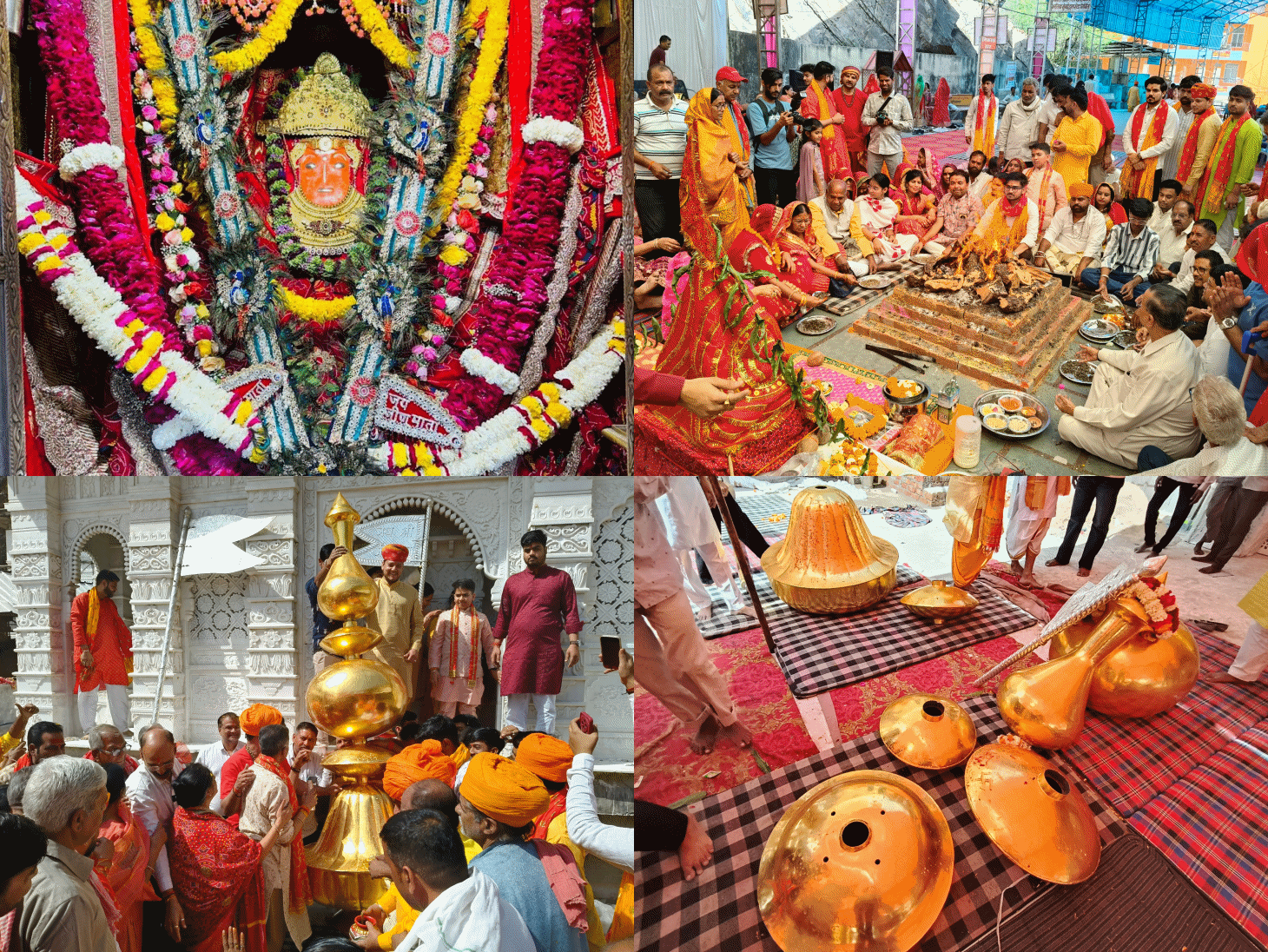
Few shrines in Rajasthan carry the emotional weight of Jeen Mata. Devotees speak of her not as a distant deity but as a mother of the house. She is the kuldevi (family goddess) whose blessing is sought before a wedding, whose threshold receives a child's first haircut, and whose name is called out in the long nights of Navratri. Her temple stands in the village that now bears her name, Jeenmata, in Sikar district, the heart of the historic Shekhawati region. Aravalli ridges ring it on three sides, and on clear evenings the sunset turns them copper.
According to tradition, the goddess was once a young woman named Jeen (also remembered as Jeevan), born into a Chauhan Rajput family of Ghanghu in present-day Churu district. A misunderstanding with her sister-in-law led her to renounce household life. She retreated to these hills for intense tapasya (penance) and merged into the divine power of Durga. Her devoted elder brother Harsh followed her to bring her home. When she would not return, he too sat in meditation on a neighbouring peak, and he is worshipped today as Harsh Bhairav. The two hills, and the bond between brother and sister, define the sacred geography of this valley.
The present temple shows layers of devotion across many centuries. Carved pillars bear old inscriptions, the sanctum walls have been rebuilt again and again, and a modern pilgrim mandap now shelters thousands at once. Inside, the goddess appears as an eight-armed (Ashtabhuja) form of Durga. Her radiant vermilion face is crowned in gold and framed by garlands that change with every shringar. An akhand jyoti (perpetual lamp) has burned before her for generations, and keeping it lit is part of the temple's oldest stories.
या देवी सर्वभूतेषु शक्तिरूपेण संस्थिता।
नमस्तस्यै नमस्तस्यै नमस्तस्यै नमो नमः॥"To that Goddess who dwells in all beings as Power, salutations to Her, salutations to Her, salutations again and again."
Devi Mahatmya (Durga Saptashati), Chapter 5
This verse from the Devi Mahatmya is recited daily in the temple. It sums up how devotees see Jeen Mata: not a separate goddess, but the same universal Shakti that Hindu scripture praises as Durga, Chandi and Bhawani, made present in one local story and one sacred hill. That is why pilgrims from Haryana, Gujarat, Maharashtra, West Bengal, Assam and the Gulf countries travel back to this small Rajasthan village. For many families with Shekhawati roots, Jeen Mata is the ancestral anchor that keeps them tied to the land of their forefathers.
One Shakti, many names
Hindu theology holds that the Supreme Goddess (Mahadevi) takes countless forms to protect dharma. As Durga she defeats the buffalo-demon Mahishasura. As Kali she destroys arrogance. As Gauri she blesses households with harmony. Jeen Mata belongs to this tradition. Devotees call her Jeen Bhawani, Bhawani being one of Durga's most loved names in Rajasthan.
Her iconography follows Durga's warrior form: the eight arms, the trishul (trident), the lion as her mount, and the red and gold that stand for shakti and auspiciousness. Like many Rajasthani kuldevis, she is also intensely personal. She is the daughter who left home, the sister who chose the divine, and the mother who still answers when her children call.
Marble and painted Durga idols like the one shown here are kept in homes and in small shrines across Shekhawati. They show how the goddess of the hill reaches into everyday family worship.
Discover Her Story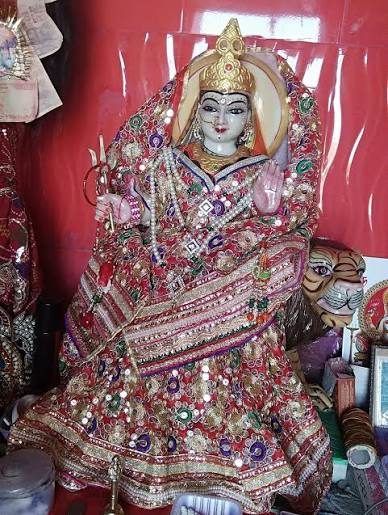
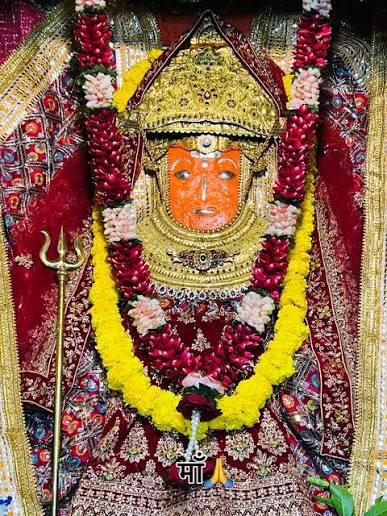
A darshan that stays with you
Ask a returning pilgrim what draws them back and you will rarely hear about architecture. You will hear about a moment: the first sight of the Goddess's face through the crowd, the sound of conch shells at dawn, the taste of prasad on the drive home.
- Kuldevi worship: many Rajput, Agrawal, Brahmin, Jat, Meena and other families visit to fulfil ancestral vows and family rites.
- Jadula and mundan: a child's first haircut is offered at the Goddess's feet, a custom handed down over generations.
- Mannat (vows): devotees tie sacred threads, offer chunari and coconuts, and return to give thanks when their prayers are answered.
- Navratri mela: twice a year the village becomes a sea of red flags, devotional music and all-night jagrans.
- Natural beauty: the Aravalli setting, especially in the monsoon green and in winter light, makes the journey itself a pilgrimage.
Everything you need for a meaningful pilgrimage
Whether you are planning your first visit, returning for a family ceremony, or simply want to know more about the Goddess, each section of this guide goes into depth.
The Legend of Jeen & Harsh
The Chauhan princess of Ghanghu, the quarrel over a water pot, a brother's devotion, the miracle of the bees, and a thousand years of inscriptions.
Architecture
Carved pillars, the garbhagriha, the pilgrim mandap and the perpetual lamp.
Darshan & Aarti
Daily aarti rhythm, shringar, offerings and step-by-step darshan.
Navratri Mela
The great Chaitra and Ashwin fairs, jagrans and seasonal celebrations.
Plan Your Visit
Road, rail and air routes, stays, seasons and nearby shrines.
Why Jeen Mata matters to Rajasthan's sacred landscape
A bridge between folk faith and classical Shaktism
Rajasthan's religious life has long been shaped by kuldevi shrines, temples where a lineage-goddess is honoured by all of a clan's descendants wherever they live. Karni Mata at Deshnoke, Shakambhari near Sambhar, Sakrai Mata and Kaila Devi near Karauli are well-known examples. Jeen Mata belongs to this network but stands out because of how fully her local legend has merged with classical Durga worship. Her story begins as a human drama about family, honour and renunciation, yet her temple rituals follow the Sanskrit texts of the Shakta tradition. The Durga Saptashati is recited, Navratri is the ritual peak, and the iconography is that of Mahishasuramardini.
A sacred geography of brother and sister
The paired worship of Jeen Mata and Harsh Bhairav reflects a pattern seen across north Indian folk religion, where a goddess is protected by a guardian Bhairav. Here the guardian is also her brother, and the landscape tells the story. The Harsh hill, with the remains of the historic Harshnath temple complex associated with the Chahamana (Chauhan) period, rises within sight of the Jeen Mata shrine. Pilgrims traditionally pay respects to both, and many believe a visit to the sister is incomplete without honouring the brother.
A living heritage economy
The temple sustains a whole village. Prasad and flower sellers, chunari and bangle shops, dharamshala managers, taxi drivers, cooks and folk musicians all depend on the steady flow of pilgrims, and on the huge surge during the two Navratri fairs. For the Shekhawati region, better known for its painted havelis and business families, Jeen Mata is a reminder that the area's identity is spiritual as well as mercantile.
Continuity across a millennium
Few places of worship can show the kind of continuity found here. Inscriptions on the temple pillars, generations of royal and mercantile patronage, and a rich oral tradition of the Mughal-era miracle of the bees together record a sanctum that has been in active worship for roughly a thousand years. Read the full story on our Legend & History page.
Planning a family pilgrimage or a ceremony at Jeen Mata?
Talk to Mr. Digant Sharma for guidance on visiting the temple, timing your trip around Navratri, or any other enquiry about Jeenmata.in.