॥ जय जीण भवानी ॥
  1. Home
  2. Legend & History
The story behind the shrine

The Legend of Jeen & Harsh

A daughter of the Chauhans who chose the divine over the household, a brother who would not let her go alone, and a hill that has held their story for more than a thousand years.

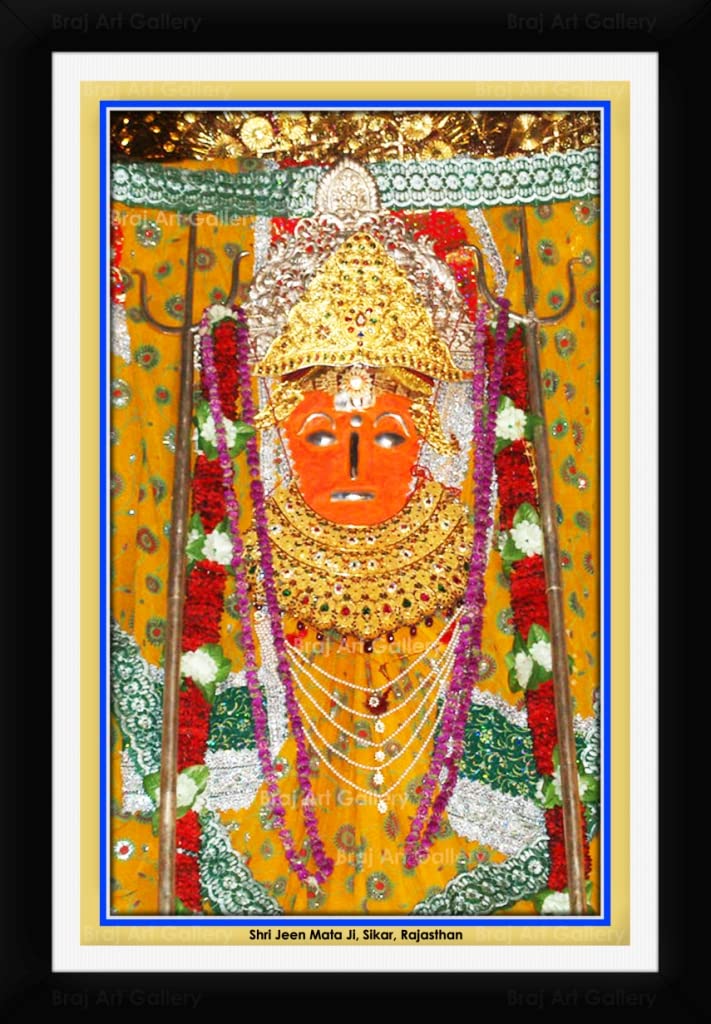
Framed traditional portrait of Shri Jeen Mata Ji, Sikar, Rajasthan, with golden crown, vermilion face, rose garlands and trishul
Shri Jeen Mata Ji, Sikar: a traditional devotional portrait of the Goddess.
IThe Birth

A daughter of the Chauhans at Ghanghu

The oral tradition of Shekhawati, kept alive in folk songs, temple narrations and the bhajans sung at night-long jagrans, begins in the village of Ghanghu in what is now Churu district. Here, it is said, lived a Chauhan Rajput chief whose household was blessed with two children: a son, Harsh, and a daughter, Jeen (often remembered by the fuller name Jeevan).

The Chauhans, or Chahamanas as early inscriptions call them, were one of the most important Rajput dynasties of medieval north-western India. From centres such as Shakambhari (Sambhar) and later Ajmer, their branches ruled across the region that now includes Sikar, Churu and Nagaur. Placing Jeen in this lineage gives the legend deep regional roots. It links the goddess to the same royal and martial culture that built the forts and temples of early medieval Rajasthan.

Every version of the story agrees on one thing: brother and sister were devoted to each other. Some versions say their mother died early and Harsh, the elder, cared for Jeen almost like a parent. This makes the later separation even more painful, and it explains why the bond between Jeen Mata and Harsh Bhairav is still the emotional centre of worship here.
IIThe Test

The quarrel over a water pot

When Harsh married, his wife and his sister shared the household. The most widely told version of the legend says the two women went to fetch water together, each carrying an earthen pot on her head. Teasing turned to rivalry, and they agreed to a wager. Harsh would be waiting at the gate, and whichever pot he lifted down first would show whom he loved more.

Harsh, perhaps without thinking, lifted his wife's pot first. To Jeen, who had given her whole heart to her brother, this ordinary moment felt like being cast aside. Folk singers dwell on it with great tenderness. Nothing violent happens and no harsh word is spoken; a young woman simply understands that her place in the world has changed. Hurt but calm, she decided to leave home and dedicate herself entirely to the divine.

"The legend turns on a small domestic moment, the order in which two pots were lifted, and from it grows a renunciation that lasts a thousand years."

Some later versions add details, such as a sharp remark from the sister-in-law. The core stays the same: Jeen's departure is an act of spiritual resolve, not of anger. In the way devotees tell it, the household drama was only the outer cause. The inner cause was the goddess within her waking up.

IIIThe Penance

Tapasya in the Aravalli hills

Jeen walked south from the sand country of Ghanghu to the rocky folds of the Aravalli range near present-day Rewasa and Sikar. In a quiet cleft of the hills, beside a seasonal spring, she sat in tapasya, the austere meditation through which the sages of the Puranas gained union with the divine. Tradition says her penance was so intense that the Goddess Durga herself appeared, and Jeen merged into her: the mortal woman became Jeen Bhawani.

This idea, a human devotee absorbed into the Supreme Goddess, appears throughout Rajasthan's kuldevi traditions. It lets the goddess be both universal and personal. Jeen Mata is Durga, the slayer of Mahishasura, and she is also "our daughter", the girl from Ghanghu who still listens to family troubles.

IVThe Brother

Harsh follows, and becomes Harsh Bhairav

Full of remorse, Harsh set out after his sister. He found her deep in meditation and begged her to come home. Jeen gently refused, because her path now led only to the Goddess. Unable to return without her and unwilling to abandon her, Harsh climbed a neighbouring hill and began his own penance, facing his sister's peak. Through that devotion he too reached the divine and is worshipped as Harsh Bhairav, a form of the guardian deity Bhairav who stands watch over Shakti shrines across India.

The Harsh hill (Harsh Parvat) near Sikar is home to the ruins of the celebrated Harshnath temple complex. A long Sanskrit inscription found there, known to historians as the Harsha stone inscription and dated to 973 CE, records the shrine's patronage under the Chahamana (Chauhan) ruler Vigraharaja II. The hill is therefore one of the best-documented early medieval religious sites in Rajasthan. It also shows that the brother-sister landscape of the Jeen Mata legend lies within a historically rich Chauhan-era sacred zone.

Pilgrims traditionally visit both shrines. Many families first take darshan of Jeen Mata and then pay respects to Harsh Bhairav, believing that the brother's blessing completes the sister's.

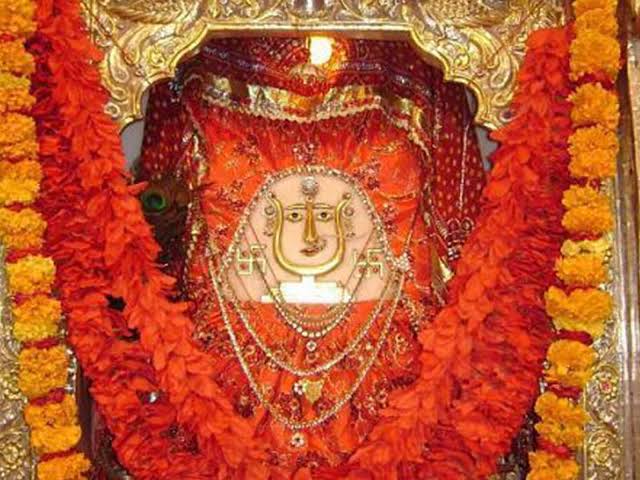
Ancient silver mukhota face of Jeen Mata with swastika symbols, framed by orange and yellow marigold garlands in a gilded shrine
A silver mukhota (face-form) of the Goddess, framed by marigolds and swastika marks.
Symbols of the Goddess

The mukhota: a face that holds a lineage

In many Rajasthani shrines the divine is shown not by a full sculpted body but by a mukhota, a metal face of silver or gold placed over the sacred form beneath and dressed in fresh cloth for each shringar. The image here shows such a face: wide, steady eyes, a serene mouth and a forehead mark, with the auspicious swastika painted on either side.

Each element has meaning. In Hindu use the swastika (from Sanskrit su-asti, "it is well") stands for good fortune and the turning of the cosmic cycle, and it is drawn on thresholds, account books and wedding invitations across Rajasthan. Marigolds, cheap and plentiful in the region, are offered by the basketful because their saffron colour is linked to sacrifice and devotion. Silver, for the many families who donate ornaments to the Goddess, is both an offering and a family heirloom held in trust by the deity.

Similar face-forms are kept in households and in small family shrines dedicated to Jeen Mata. They let the Goddess "travel" with a lineage when it migrates to Kolkata, Mumbai or Assam, while the original sanctum stays rooted in Sikar.

VThe Miracle

The miracle of the bees: Bhanwar wali Mata

The most famous story about Jeen Mata Temple comes from the Mughal period. According to tradition, an imperial army, usually linked in popular memory with the reign of Aurangzeb (1658–1707), reached the temple intending to desecrate it. As soldiers moved towards the sanctum, swarms of bees (bhanwar or madhumakkhi) poured out of the hills and attacked them so fiercely that the army had to retreat.

The tradition goes on to say that the emperor, humbled, sent an offering to the Goddess, most often described as a regular supply of oil or ghee for the temple's akhand jyoti (perpetual lamp). Because of this story Jeen Mata is lovingly called "Bhanwar wali Mata", the Goddess of the bees. Devotees still treat the bee as her protector.

Historians are careful with such accounts. Stories of shrines defended by swarms, serpents or sudden storms appear in many parts of India, and they record how communities remembered resistance as well as what physically happened. Whatever its literal truth, the story is clear about meaning: the Goddess protects her own, and no worldly power is greater than the faith of her devotees. That is why it is retold at every jagran and why the akhand jyoti stays at the centre of temple ritual.

Three pillars of the tradition

What the legend teaches devotees

Renunciation with grace

Jeen leaves home without bitterness. Devotees see in her an ideal of letting go: one can step away from hurt and towards a higher purpose without destroying what came before.

Women in particular have long seen Jeen Mata as a protector who understands family tensions.

The unbreakable sibling bond

Harsh's choice to stay near his sister rather than go home alone is one of the most moving images in Rajasthani folk religion.

On Raksha Bandhan and Bhai Dooj, many families remember Jeen and Harsh as the model of loyalty between brother and sister.

Divine protection

From the bees that turned back an army to the lamp said never to have gone out, the temple's stories keep returning to protection.

Pilgrims ask Jeen Mata to guard their homes, children, journeys and livelihoods, as she guarded her own hill.

Through the centuries

A timeline of devotion

Dates in folk tradition and dates in stone do not always match. This timeline brings together what inscriptions, regional history and living tradition tell us about the shrine.

  1. Antiquity

    Jeen's tapasya

    Tradition places Jeen's penance and merging into Durga in the distant past, at least a thousand years ago, among the Aravalli hills south of present-day Sikar.

  2. 973 CE

    Harsha inscription

    A Sanskrit inscription on the nearby Harsh hill records patronage of the Harshnath shrine under Chahamana ruler Vigraharaja II, documenting a flourishing Chauhan-era sacred landscape.

  3. 11th–12th c.

    Pillars and patrons

    Inscriptions on pillars within the Jeen Mata temple are generally dated to this period and record renovations and gifts by local chiefs and devotees.

  4. 17th c.

    The miracle of the bees

    Popular tradition links the Mughal attempt on the temple, and the swarming bees that defended it, with the age of Aurangzeb. It gives the Goddess the name Bhanwar wali Mata.

  5. 18th–19th c.

    Shekhawati patronage

    As the Shekhawat chiefdoms and the trading families of Shekhawati grew wealthy, gifts of silver, dharamshalas and renovations followed. Many of these families still return as kuldevi devotees.

  6. Today

    A living pilgrimage

    Daily aarti, a modern pilgrim mandap, organised queues and two great Navratri melas each year keep Jeen Mata among the most visited Devi shrines in north-eastern Rajasthan.

Walk where the legend lives

Step inside the temple to see its carved pillars, its garbhagriha and the perpetual lamp at the heart of the Jeen Mata story.

Explore the Temple