- Home
- The Temple
Inside the House of Jeen Bhawani
From the marigold-draped mandap to the vermilion face of the Goddess in the garbhagriha, every part of Jeen Mata Temple has been shaped by centuries of devotion, renovation and festival use.
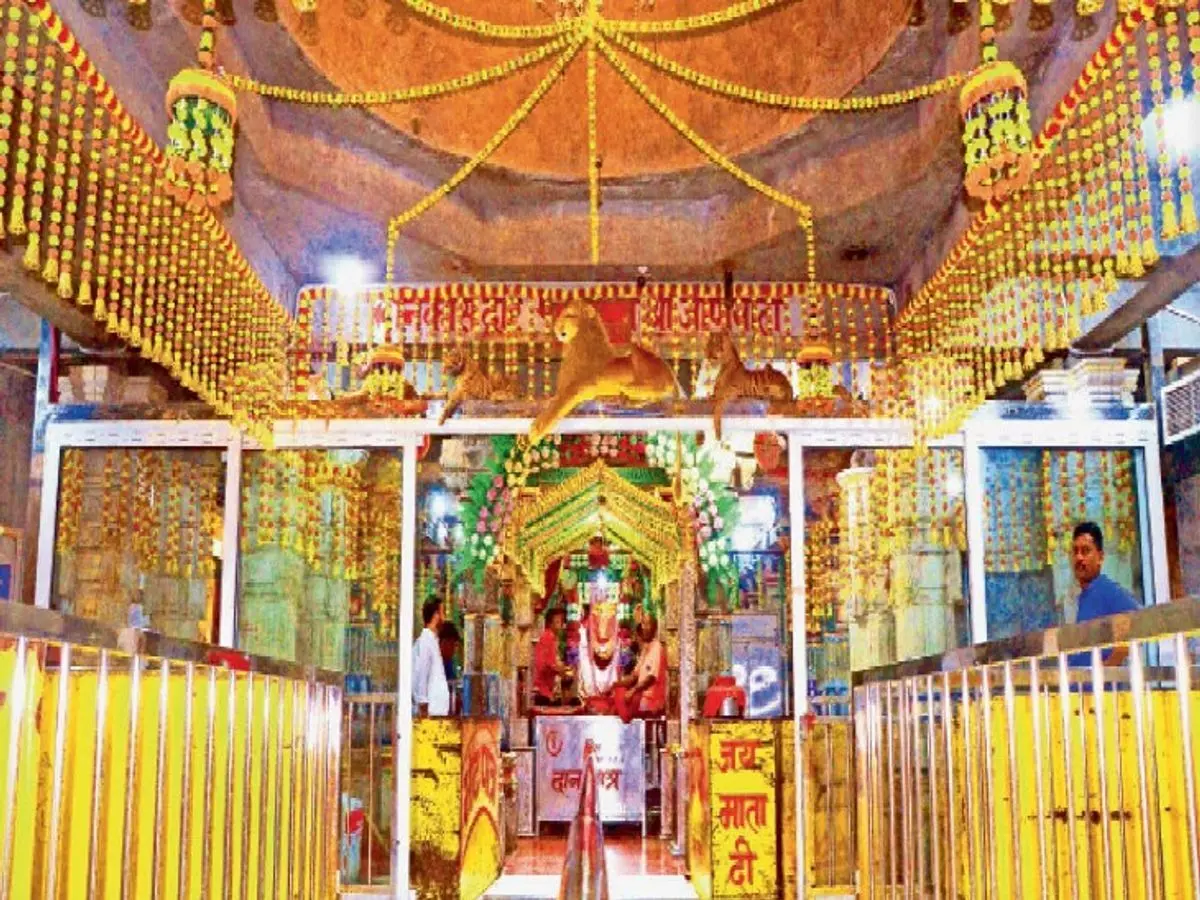
A hall built for crowds, dressed for a goddess
The photograph above shows the approach many devotees remember best: hundreds of garland strands hanging from the dome, golden lions guarding the inner doorway, and steel queue railings painted with "Jai Mata Di" leading the eye straight to the Goddess.
An architecture of layers
Jeen Mata Temple is not one building from one moment. Like many of north India's most active shrines, it is a palimpsest: an ancient core of sanctum and pillared hall, wrapped in additions made by successive generations of patrons. The oldest parts are the stone pillars and the area around the garbhagriha, where inscriptions record gifts and repairs from the early medieval period. Around this core, later centuries added marble flooring, silver-plated doors, painted ceilings and the wide domed mandap that now shelters pilgrims from the desert sun.
To a trained eye this layering is itself history. It shows that the temple was never abandoned. Worship continued without a break and every age added its own offering.
The akhand jyoti
Before the Goddess burns the akhand jyoti, a perpetual lamp tended day and night by the temple priests. Tradition links it to the Mughal-era miracle of the bees. For devotees, its unbroken flame stands for the Goddess's unbroken presence.
Inscribed pillars
Stone pillars inside the temple carry old inscriptions in Sanskrit and early Devanagari. They are generally dated to the eleventh and twelfth centuries and record devotees' gifts and repairs to the shrine.
Lions at the threshold
Golden lions crown the inner doorway, echoing the vahana (mount) of Durga. They mark the line between the busy mandap and the sacred stillness of the sanctum.
The domed ceiling
The broad dome over the mandap is festooned with marigold strands during festivals, creating a canopy of saffron and green that is one of the temple's best-loved sights.
The eight-armed Goddess in the sanctum
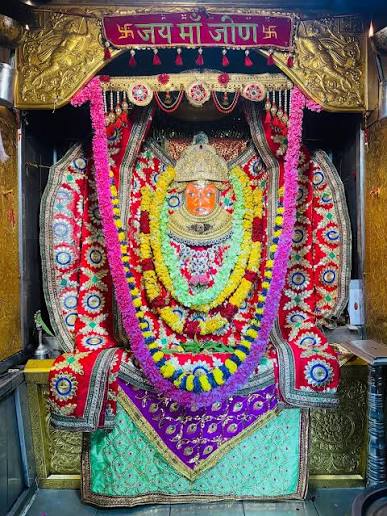
At the heart of the temple is the garbhagriha, the "womb chamber", where Jeen Mata is enthroned beneath a gilded canopy marked जय माँ जीण.
The Goddess is worshipped as an Ashtabhuja (eight-armed) form of Durga. Her face, glowing with sindoor, is crowned with a tall golden mukut and set in rows of jewellery. Most of her form is wrapped in richly embroidered poshak (ceremonial garments) that change with every shringar: deep reds and greens on ordinary days, heavier gold-work during Navratri, and seasonal colours for festivals such as Holi and Diwali.
Garlands are central to the darshan. As the photograph shows, long strands of magenta, yellow, green and white flowers are draped from the canopy down around the Goddess, forming a living frame that changes each day. On either side, gold-plated panels with floral and peacock motifs fill the sanctum walls. A trishul and other weapons of the Goddess are often placed beside her, reminding devotees of her role as protector.
Only the temple's hereditary pujaris (priests) enter the sanctum. Pilgrims take darshan from the threshold, where they offer coconuts, chunari and sweets through the priests and receive prasad and a touch of sacred ash or sindoor in return.
Walking the temple, zone by zone
Knowing how the complex fits together helps first-time visitors move calmly through it, especially on busy festival days.
Approach & bazaar
The lane leading to the temple is lined with stalls selling chunari, coconuts, prasad boxes, flowers, bangles and devotional photos. Footwear stands are found here as well.
Main gateway
A decorated entrance marks the start of the sacred precinct. Devotees often touch the threshold and bow before stepping inside.
Queue galleries
Railed galleries guide the line of pilgrims towards the sanctum. On Navratri days the queues stretch far beyond the mandap and move in an orderly flow.
The domed mandap
The large assembly hall where devotees gather for aarti, sing bhajans and wait for darshan. It is the setting of the temple's famous garland canopy.
Garbhagriha
The inner sanctum of Jeen Mata, guarded by lions and lit by the akhand jyoti. Darshan is taken from the threshold.
Subsidiary shrines
Smaller shrines within and around the complex honour associated deities. Many pilgrims also go on to the Harsh Bhairav shrine on the neighbouring hill.
Honouring the Goddess's house
Jeen Mata Temple is an active place of worship, not a museum. These guidelines, drawn from common practice at Rajasthan's Devi shrines, help every visitor show respect.
Please do
- Dress modestly. Traditional Indian wear is ideal, and shoulders and knees should be covered.
- Remove footwear at the designated stands before entering the precinct.
- Wait patiently in the queue. It is part of the pilgrimage and moves steadily.
- Follow the instructions of temple staff and volunteers, especially during festivals.
- Offer prasad and chunari through the priests, and accept prasad with your right hand.
- Keep children close and plan a meeting point in case you get separated in the crowd.
Please avoid
- Photographing the sanctum where signs or staff ask you not to.
- Bringing leather goods, alcohol, tobacco or non-vegetarian food into the precinct.
- Pushing or jumping the queue. The Goddess's darshan is for everyone equally.
- Speaking loudly or using phones on speaker during aarti.
- Leaving litter or plastic on the hills. Keep the Aravallis as pure as the shrine.
- Feeding or disturbing bees and monkeys around the hill paths.
Know when to arrive for aarti
See the daily rhythm of mangla, shringar, bhog, sandhya and shayan aarti, with a step-by-step guide to darshan.